/ Evolving a Design System
Yahoo Finance / Principal Product Designer / Q4 2025, Q1 2026
Integration strategy
Presentations
Stakeholder deck
Documentation
Cross-team coordination
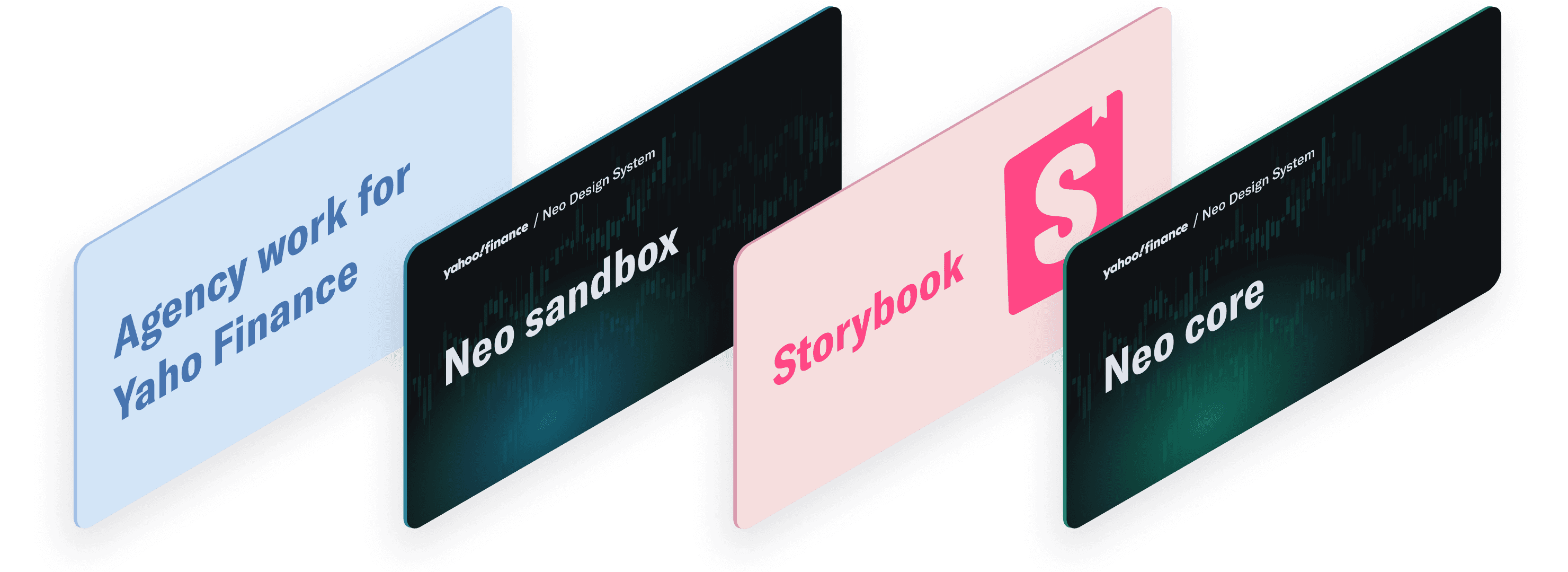
Agency files (🚫 Do not use)
Neo sandbox (🔵 For approved pilots only)
Storybook code repository (🟢 Code source of truth)
Neo core (🟢 Design source of truth)
Evolve, don't fork
When new leadership came in at the end of 2025, they brought an outside agency with them to redefine Yahoo Finance's visual direction. The work was strong. The question was never whether to use it. The question was how to bring it into a living system without blowing up everything that already worked. On top of that, I had to make a case to leadership who, understandably, wanted a clean break from what came before.
/ Evolving a Design System
Yahoo Finance / Principal Product Designer / Q4 2025, Q1 2026
Integration strategy
Presentations
Stakeholder deck
Documentation
Cross-team coordination
Agency files (🚫 Do not use)
Neo sandbox (🔵 For approved pilots only)
Storybook code repository (🟢 Code source of truth)
Neo core (🟢 Design source of truth)
Evolve, don't fork
When new leadership came in at the end of 2025, they brought an outside agency with them to redefine Yahoo Finance's visual direction. The work was strong. The question was never whether to use it. The question was how to bring it into a living system without blowing up everything that already worked. On top of that, I had to make a case to leadership who, understandably, wanted a clean break from what came before.
/ Evolving a Design System
Yahoo Finance / Principal Product Designer / Q4 2025, Q1 2026
Integration strategy
Presentations
Stakeholder deck
Documentation
Cross-team coordination
Agency files (🚫 Do not use)
Neo sandbox (🔵 For approved pilots only)
Storybook code repository (🟢 Code source of truth)
Neo core (🟢 Design source of truth)
Evolve, don't fork
When new leadership came in at the end of 2025, they brought an outside agency with them to redefine Yahoo Finance's visual direction. The work was strong. The question was never whether to use it. The question was how to bring it into a living system without blowing up everything that already worked. On top of that, I had to make a case to leadership who, understandably, wanted a clean break from what came before.
/ Evolving a Design System
Yahoo Finance / Principal Product Designer / Q4 2025, Q1 2026
Integration strategy
Presentations
Stakeholder deck
Documentation
Cross-team coordination
Agency files (🚫 Do not use)
Neo sandbox (🔵 For approved pilots only)
Storybook code repository (🟢 Code source of truth)
Neo core (🟢 Design source of truth)
Evolve, don't fork
When new leadership came in at the end of 2025, they brought an outside agency with them to redefine Yahoo Finance's visual direction. The work was strong. The question was never whether to use it. The question was how to bring it into a living system without blowing up everything that already worked. On top of that, I had to make a case to leadership who, understandably, wanted a clean break from what came before.
The naming problem
The larger company redesign initiative had been called Neo. The design system was also called Neo. Leadership conflated the two, which meant that when they wanted a philosophical break from the redesign era, they instinctively wanted to replace the design system too. Part of my job was making that distinction clearly and repeatedly.
Neo the redesign was over. Neo the design system was infrastructure. Six squads depended on it. Engineers had built real workflows around it. Designers used it every day. Starting over wasn't a creative decision, it was an expensive one, and the cost would have fallen entirely on teams who had nothing to do with the agency engagement. We absolutely could not afford it.
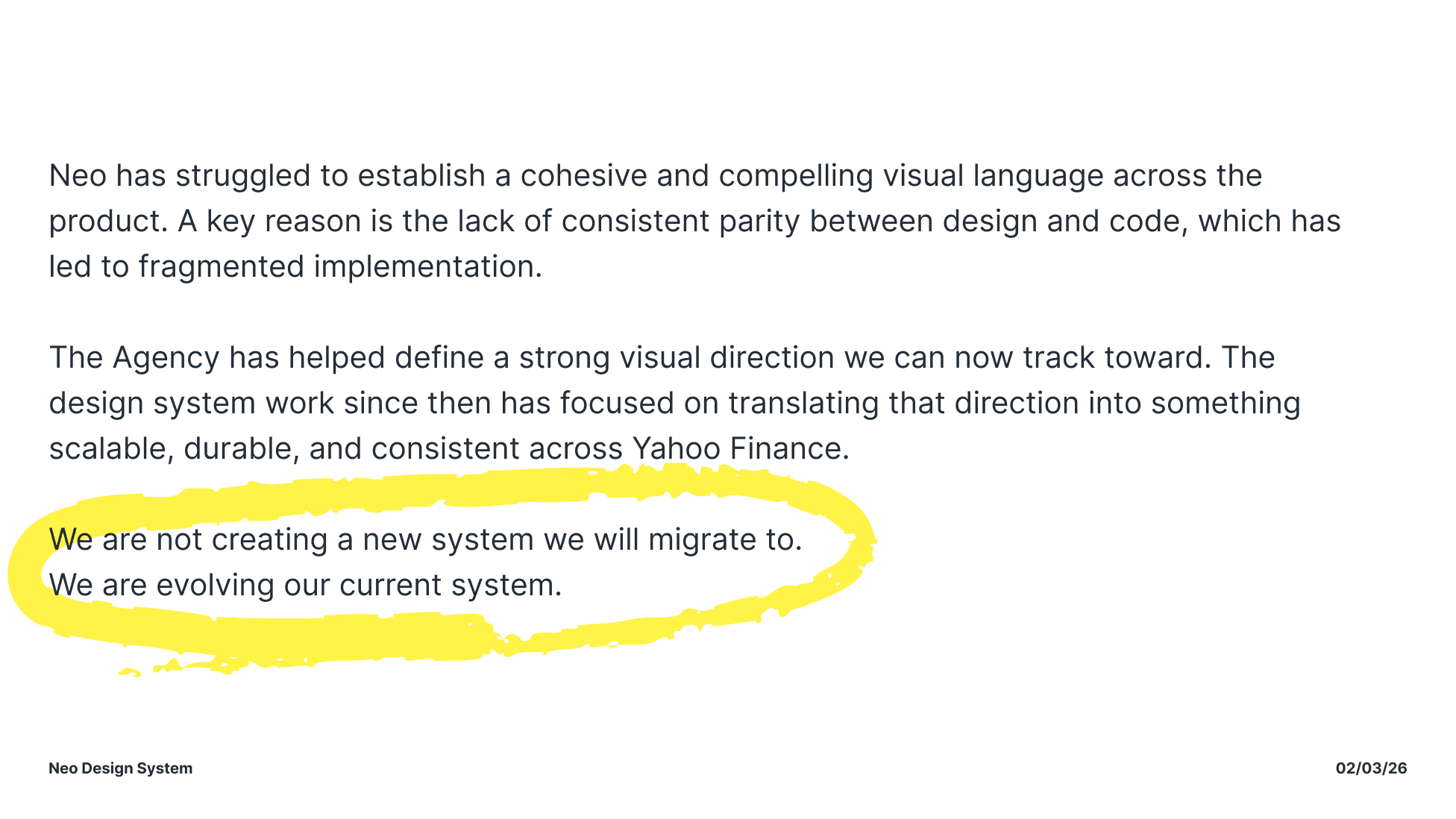
From the deck, "Evolving the Design System"
The naming problem
The larger company redesign initiative had been called Neo. The design system was also called Neo. Leadership conflated the two, which meant that when they wanted a philosophical break from the redesign era, they instinctively wanted to replace the design system too. Part of my job was making that distinction clearly and repeatedly.
Neo the redesign was over. Neo the design system was infrastructure. Six squads depended on it. Engineers had built real workflows around it. Designers used it every day. Starting over wasn't a creative decision, it was an expensive one, and the cost would have fallen entirely on teams who had nothing to do with the agency engagement. We absolutely could not afford it.
From the deck, "Evolving the Design System"
The approach we landed on
Working with leadership, we agreed on a strategy built around pilots and incremental absorption. The agency's files were the creative direction, not the source of truth. Our job was to translate that direction into something scalable and consistent with how Neo actually worked.
Two surfaces (Homepage and Crypto Hub) became the pilots. They would be the first to use new components built from the refreshed visual language. Everything else continued on Neo as it existed. New components would move into the core library only once they were ready: validated in real product, documented, and built to the same standard as everything else. No parallel system. No fork. No moment where a designer had to wonder which library was current.
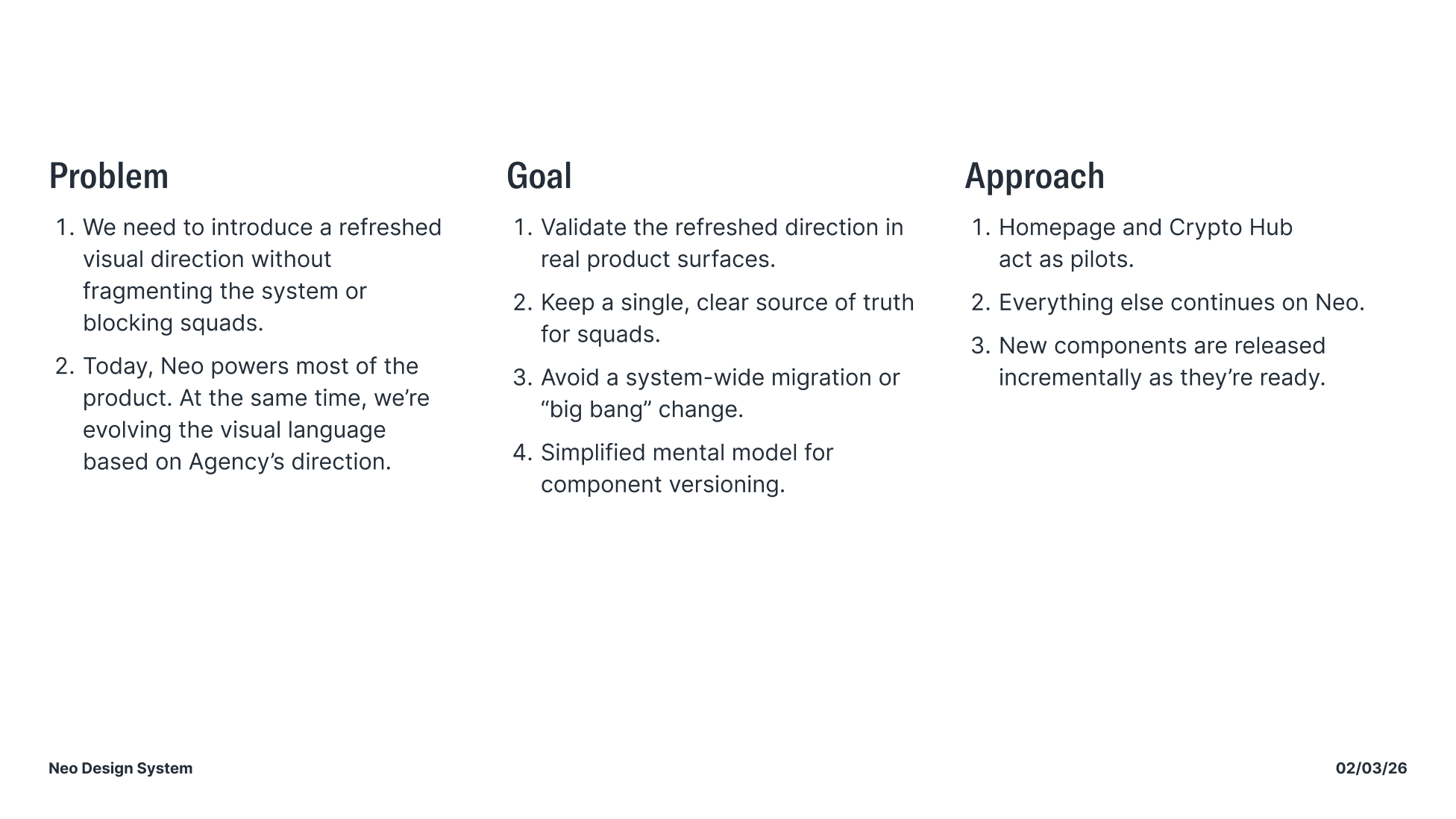
From the deck, "Evolving the Design System"
The approach we landed on
Working with leadership, we agreed on a strategy built around pilots and incremental absorption. The agency's files were the creative direction, not the source of truth. Our job was to translate that direction into something scalable and consistent with how Neo actually worked.
Two surfaces (Homepage and Crypto Hub) became the pilots. They would be the first to use new components built from the refreshed visual language. Everything else continued on Neo as it existed. New components would move into the core library only once they were ready: validated in real product, documented, and built to the same standard as everything else. No parallel system. No fork. No moment where a designer had to wonder which library was current.
From the deck, "Evolving the Design System"
How components actually moved through the system
For the incremental approach to work, everyone needed to understand exactly how a component traveled from early exploration to something teams could safely use in production. I documented this as a four-step lifecycle and included it in the stakeholder deck so engineers, designers, and PMs all had the same mental model.

Agency files (🚫 Do not use)
Neo sandbox (🔵 For approved pilots only)
Storybook code repository (🟢 Code source of truth)
Neo core (🟢 Design source of truth)
How components actually moved through the system
For the incremental approach to work, everyone needed to understand exactly how a component traveled from early exploration to something teams could safely use in production. I documented this as a four-step lifecycle and included it in the stakeholder deck so engineers, designers, and PMs all had the same mental model.
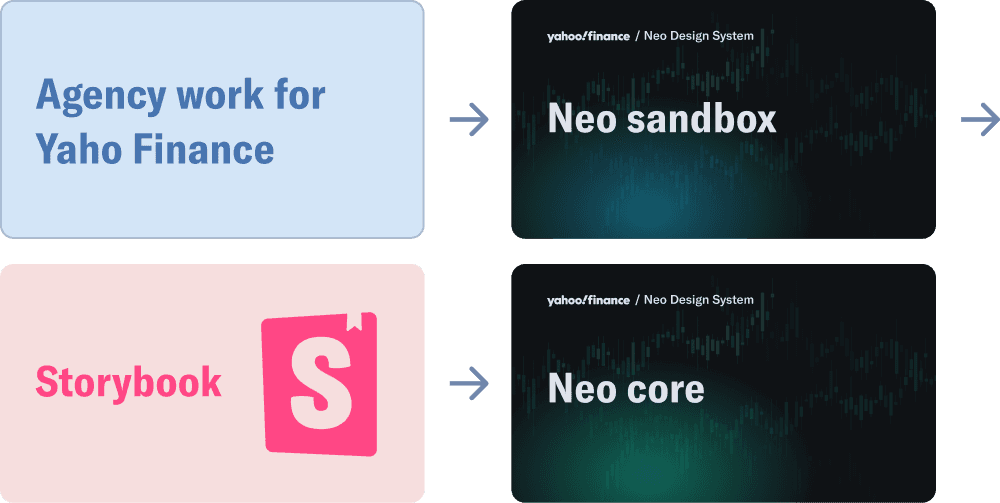
Agency files (🚫 Do not use)
Neo sandbox (🔵 For approved pilots only)
Storybook code repository (🟢 Code source of truth)
Neo core (🟢 Design source of truth)
Step 1: Design in Figma
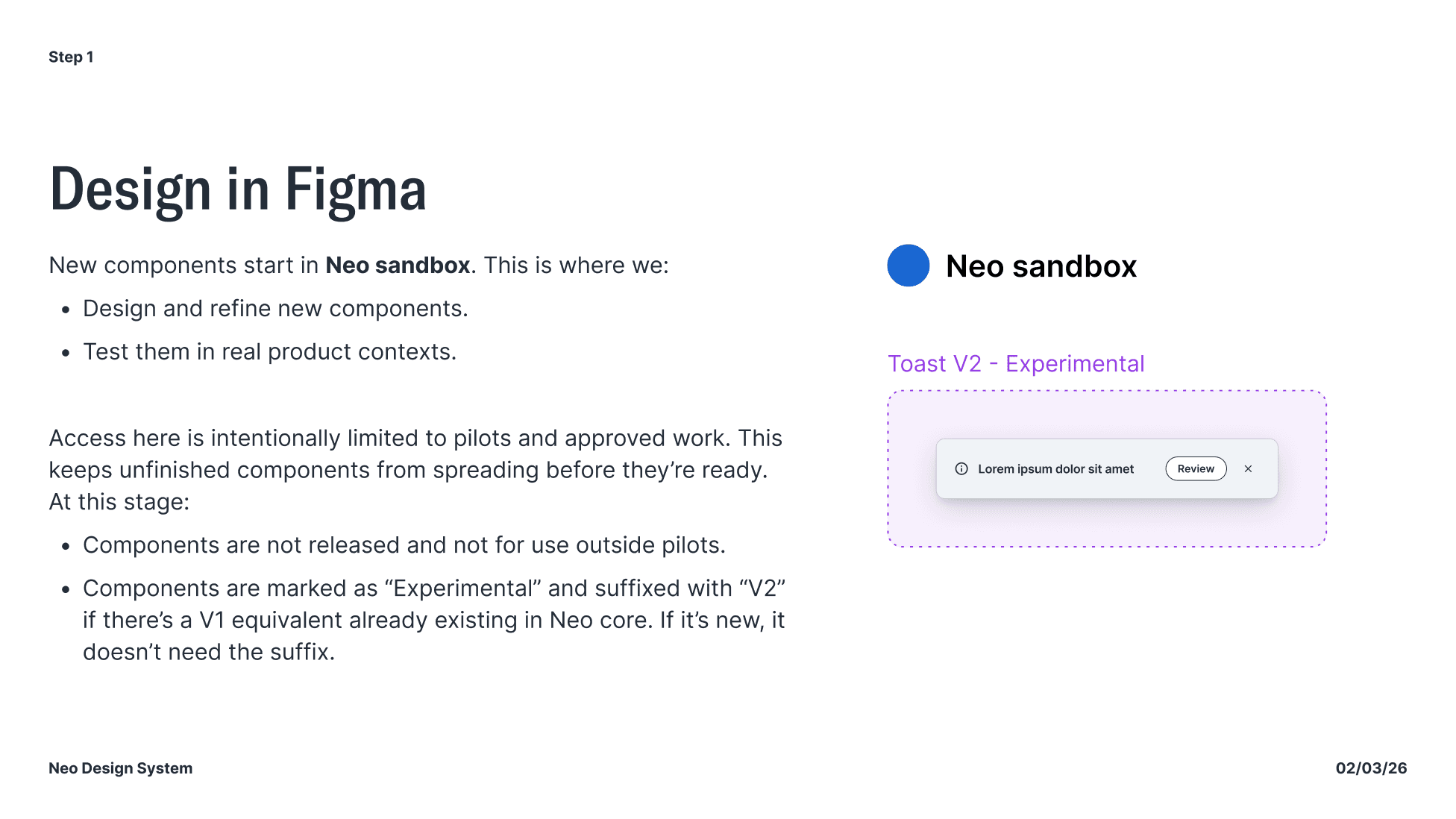
New components started in Neo sandbox, a controlled space for designing and testing in real product contexts. Access was intentionally limited to pilots. Nothing unfinished spread before it was ready. Components at this stage were marked Experimental and, if a V1 already existed in Neo core, suffixed V2.
From the deck, "Evolving the Design System"
Step 1: Design in Figma
New components started in Neo sandbox, a controlled space for designing and testing in real product contexts. Access was intentionally limited to pilots. Nothing unfinished spread before it was ready. Components at this stage were marked Experimental and, if a V1 already existed in Neo core, suffixed V2.
From the deck, "Evolving the Design System"
Step 2: Build in code
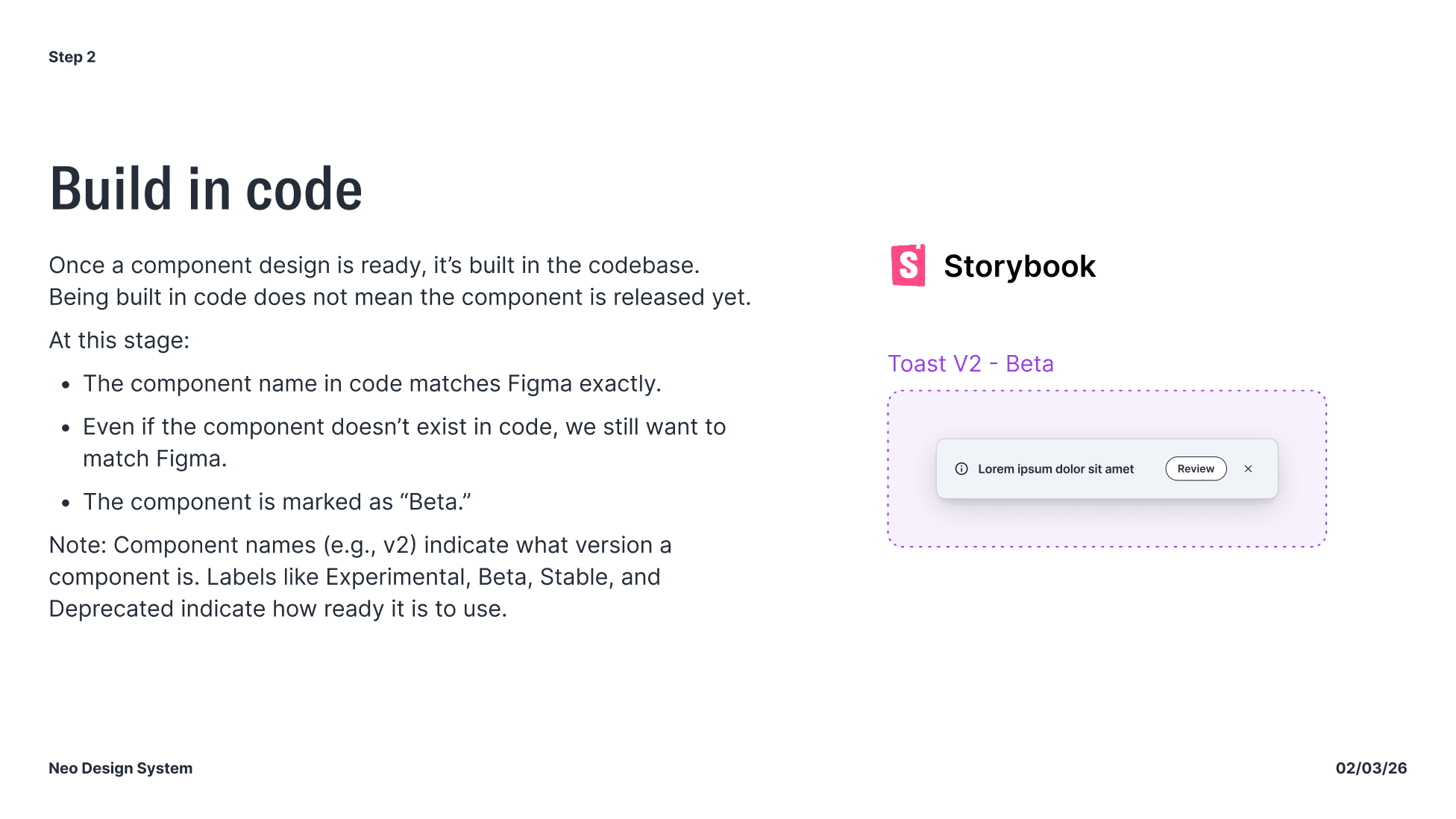
Once the design was ready, it moved to the codebase. Being in code didn't mean it was released. At this stage, the component name in code matched Figma exactly, and it was labeled Beta. The distinction mattered: version numbers (V2) told you what it was; status labels (Experimental, Beta, Stable) told you how ready it was to use.
From the deck, "Evolving the Design System"
Step 2: Build in code
Once the design was ready, it moved to the codebase. Being in code didn't mean it was released. At this stage, the component name in code matched Figma exactly, and it was labeled Beta. The distinction mattered: version numbers (V2) told you what it was; status labels (Experimental, Beta, Stable) told you how ready it was to use.
From the deck, "Evolving the Design System"
Step 3: Move into Neo core (Released)
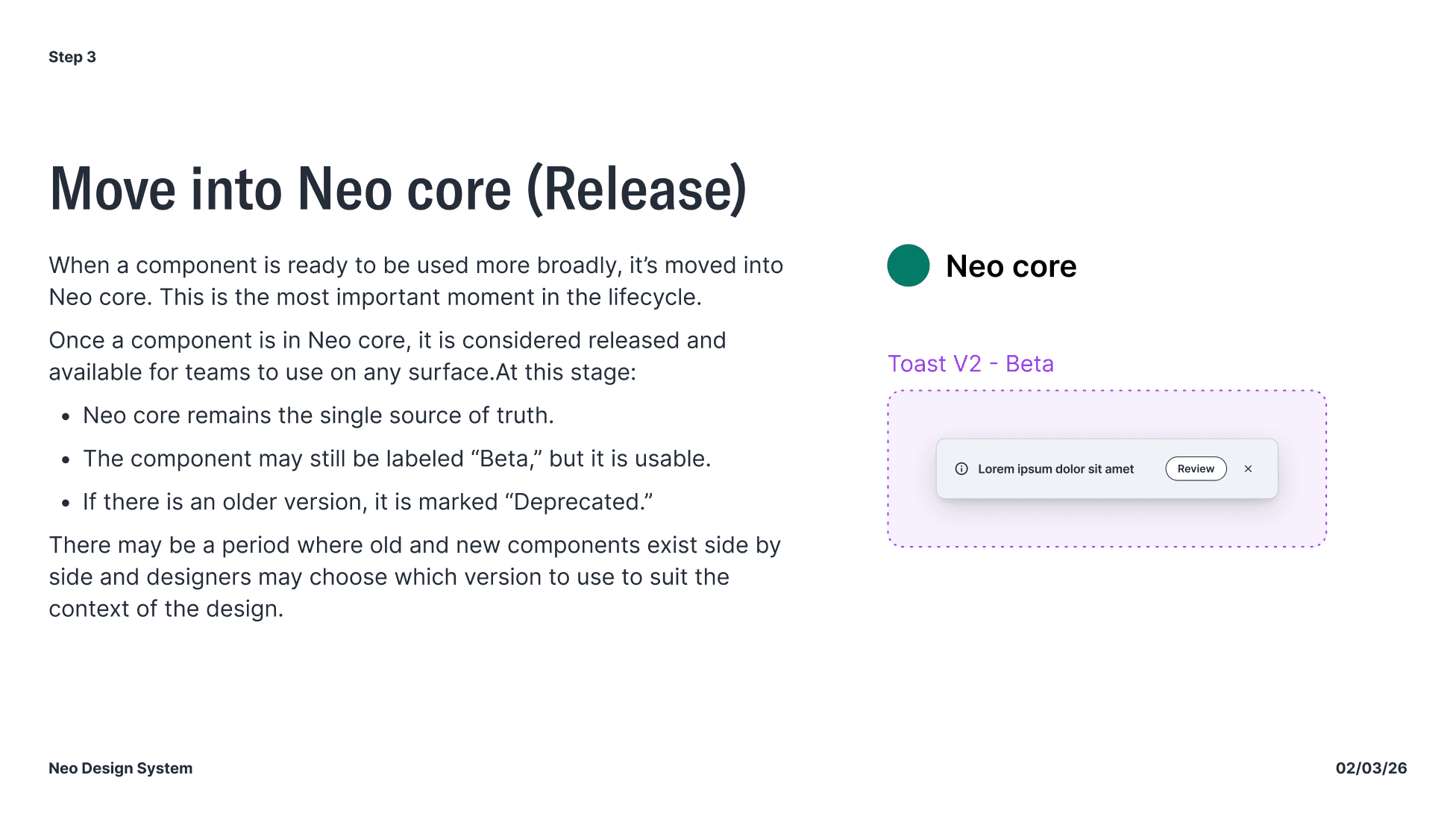
This was the most important moment in the lifecycle. When a component was validated, documented, and built to standard, it moved into Neo core — the single source of truth. At this point it was available for any team to use on any surface. If an older version existed, it was marked Deprecated. There could be a transitional window where both versions coexisted, and designers could choose whichever suited the context.
From the deck, "Evolving the Design System"
Step 3: Move into Neo core (Released)
This was the most important moment in the lifecycle. When a component was validated, documented, and built to standard, it moved into Neo core — the single source of truth. At this point it was available for any team to use on any surface. If an older version existed, it was marked Deprecated. There could be a transitional window where both versions coexisted, and designers could choose whichever suited the context.
From the deck, "Evolving the Design System"
Step 4: Communicate and stabilize
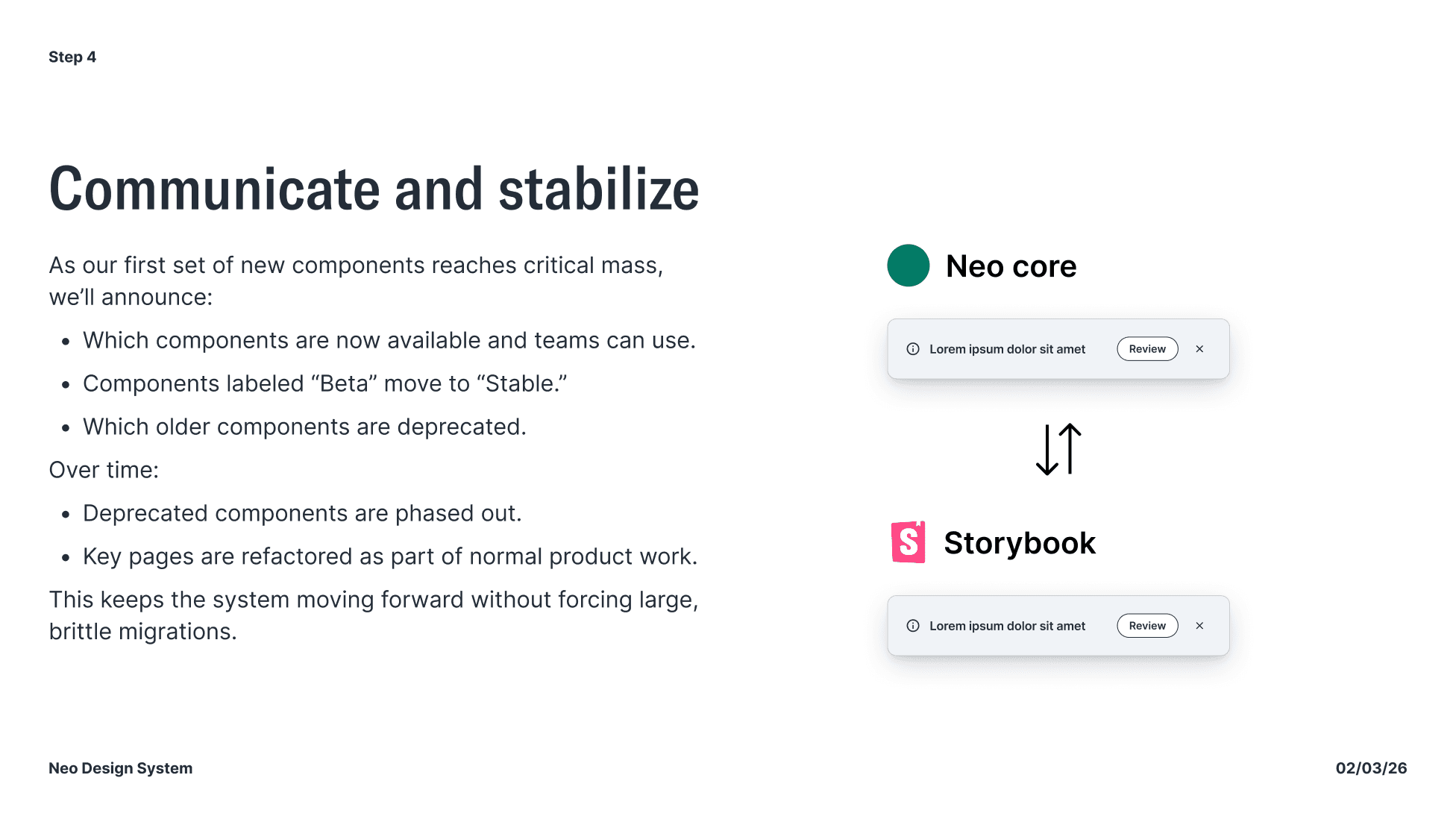
Once a critical mass of new components were in Neo core, we'd announce what was available, move Beta components to Stable, and flag what was deprecated. Older components phased out gradually as part of normal product work. No forced migrations, no big-bang moments.
From the deck, "Evolving the Design System"
Step 4: Communicate and stabilize
Once a critical mass of new components were in Neo core, we'd announce what was available, move Beta components to Stable, and flag what was deprecated. Older components phased out gradually as part of normal product work. No forced migrations, no big-bang moments.
From the deck, "Evolving the Design System"
Making the process legible day-to-day
The lifecycle told teams how a component moved through the system. But designers needed something they could act on without opening documentation every time. So we baked component status directly into the names in Figma. The name carried the answer:
Button – Stable
Divider – Deprecated
Toast – Legacy
Card V2 – Experimental
No hunting. No ambiguity. The status was visible the moment you selected a component.
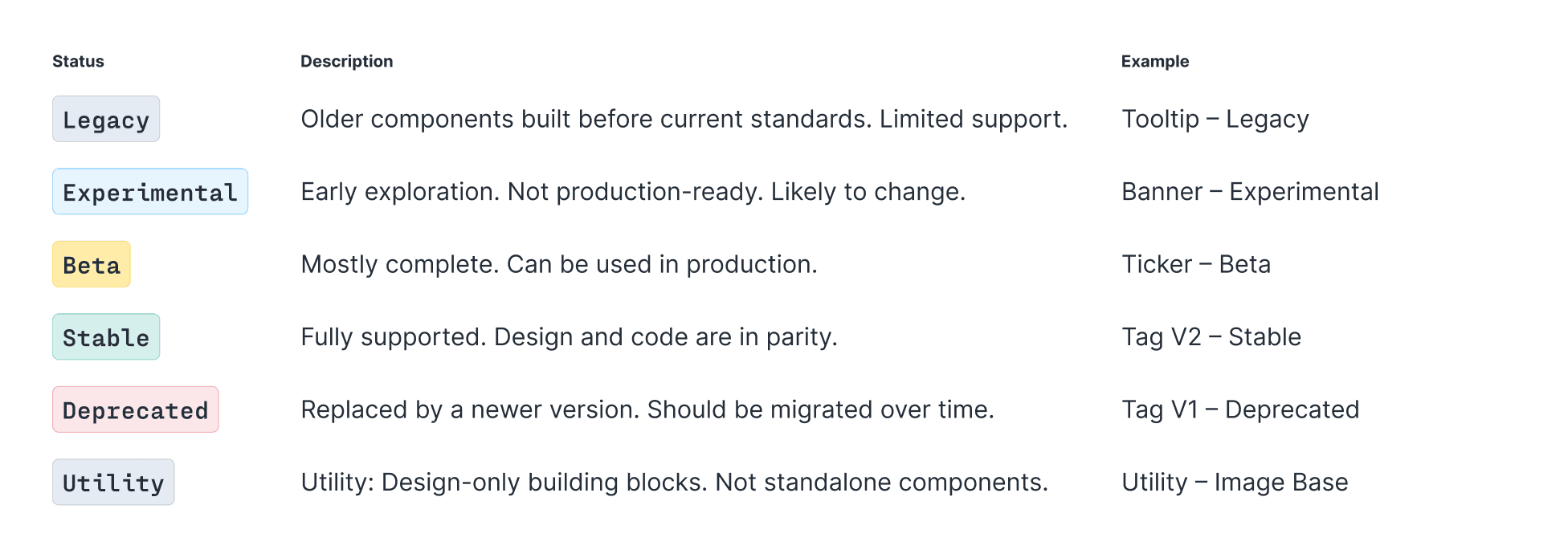
Component status guidance
Making the process legible day-to-day
The lifecycle told teams how a component moved through the system. But designers needed something they could act on without opening documentation every time. So we baked component status directly into the names in Figma. The name carried the answer:
Button – Stable
Divider – Deprecated
Toast – Legacy
Card V2 – Experimental
No hunting. No ambiguity. The status was visible the moment you selected a component.
Component status guidance
Where it stood when I left
The pilots were underway. New components were moving through the exploration environment and into Neo core as they were validated. The governance model was in place and being used. The system was absorbing the new visual direction the way it was always designed to: incrementally, without fragmentation, without stopping anyone from shipping.
The work was in progress. But the hardest part was done: making the case that evolution was smarter than replacement, building the process to execute it, and getting every discipline aligned on the same mental model. That's the work that keeps a system from fracturing when pressure is highest.
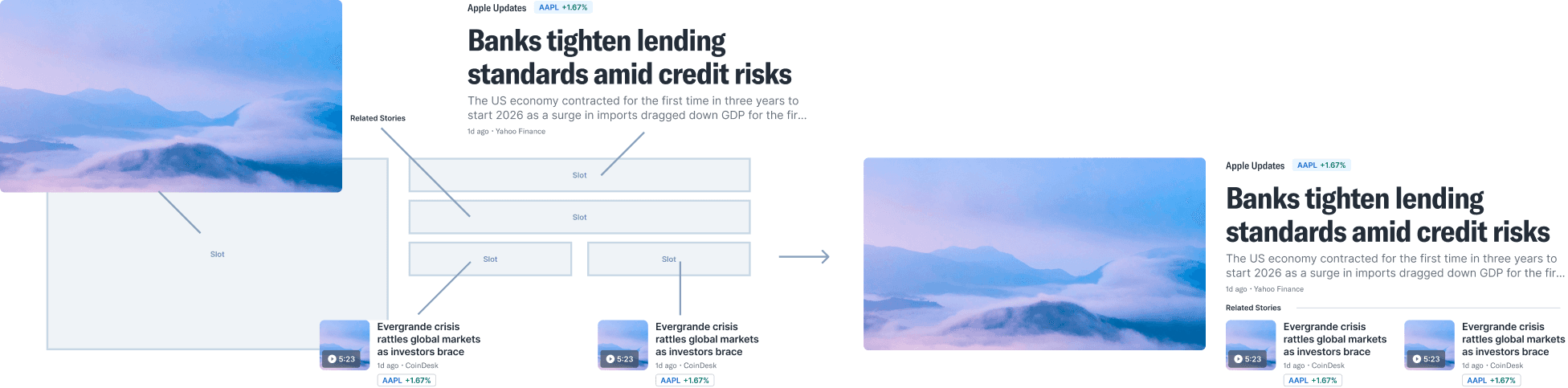
Reconfigurable nested structure for a lead story component
Where it stood when I left
The pilots were underway. New components were moving through the exploration environment and into Neo core as they were validated. The governance model was in place and being used. The system was absorbing the new visual direction the way it was always designed to: incrementally, without fragmentation, without stopping anyone from shipping.
The work was in progress. But the hardest part was done: making the case that evolution was smarter than replacement, building the process to execute it, and getting every discipline aligned on the same mental model. That's the work that keeps a system from fracturing when pressure is highest.
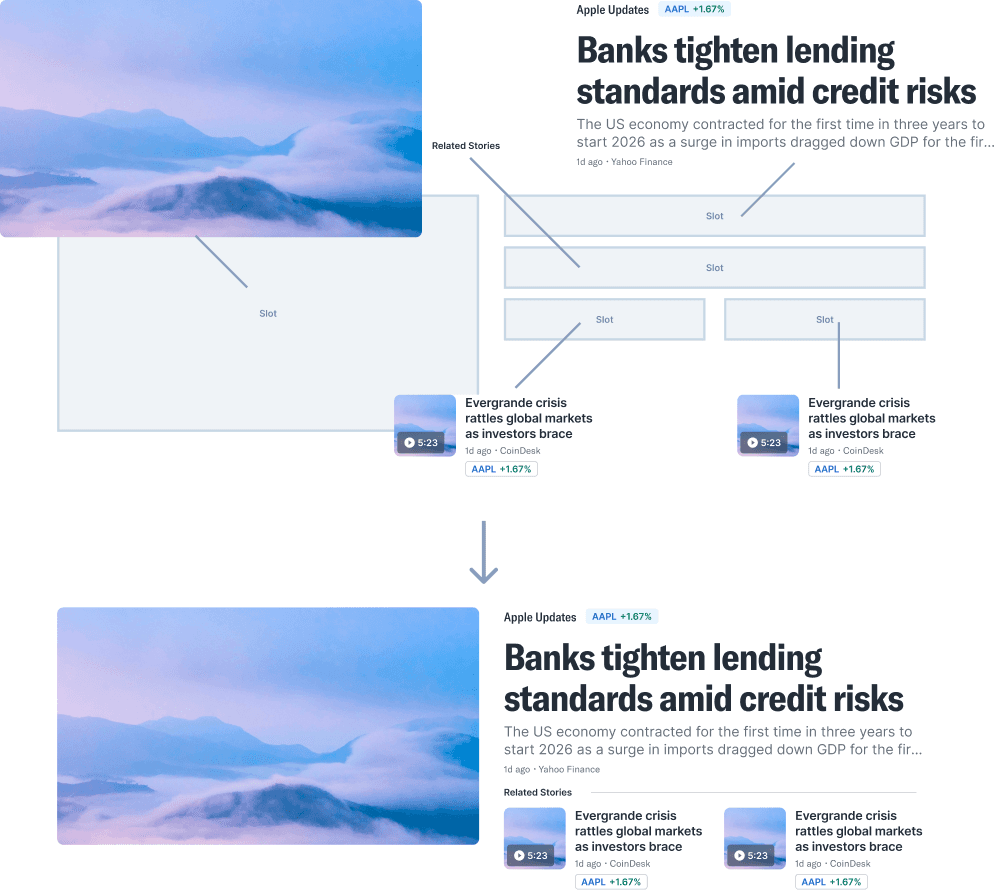
Reconfigurable nested structure for a lead story component
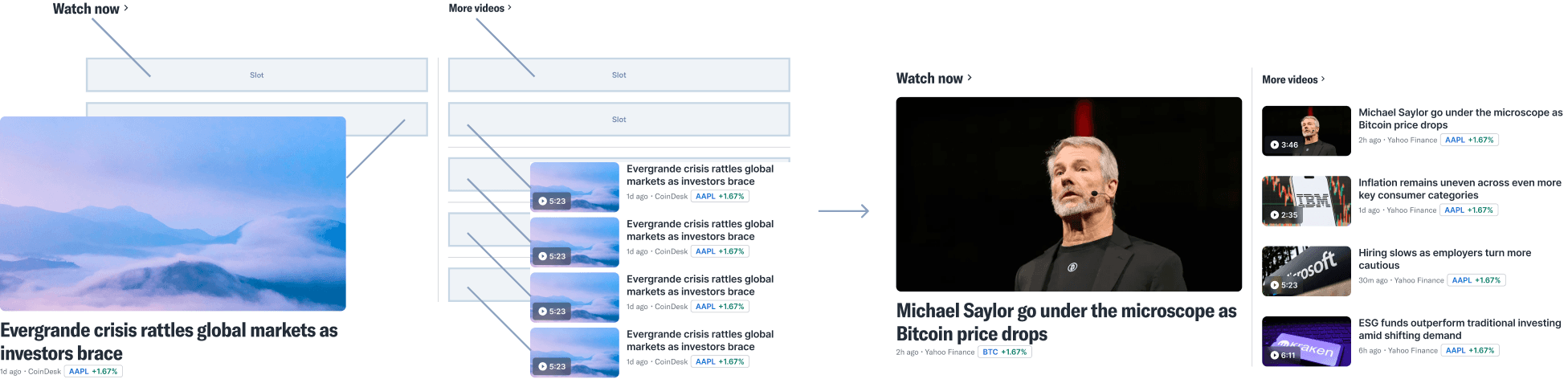
Making use of the new List component to create a page section
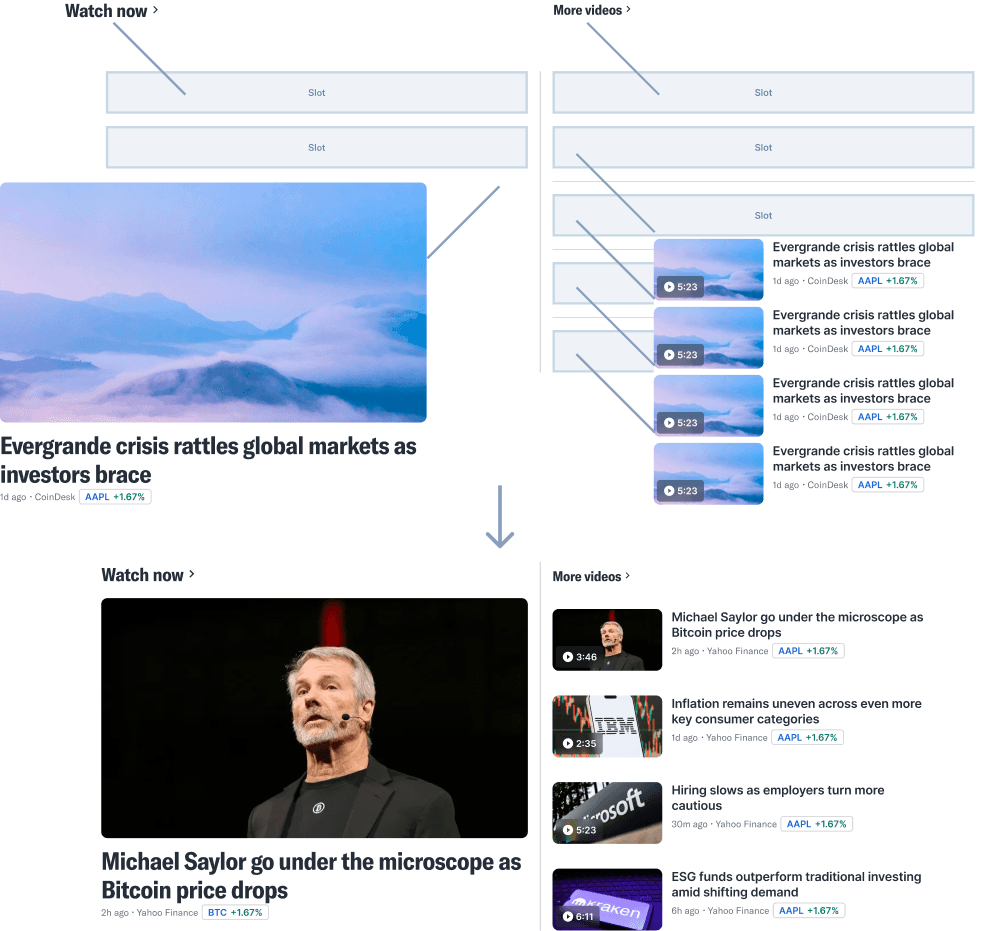
Making use of the new List component to create a page section
Related
The system that absorbed this change was built years earlier with exactly this kind of evolution in mind.
Related
The system that absorbed this change was built years earlier with exactly this kind of evolution in mind.
Related
The system that absorbed this change was built years earlier with exactly this kind of evolution in mind.
Related
The system that absorbed this change was built years earlier with exactly this kind of evolution in mind.
©2026 Drew Marshall. Site designed and built by yours truly (+ Claude)
Type set in Mori and Fraktion by Mat Desjardins and Pangram Pangram,
Slow Death by Ayyara Letterindo, IM Fell English by Igino Marini
Grid lines
Dark mode
Metal mode
.
©2026 Drew Marshall. Site designed and built by yours truly (+ Claude)
Type set in Mori and Fraktion by Mat Desjardins and Pangram Pangram,
Slow Death by Ayyara Letterindo, IM Fell English by Igino Marini
Grid lines
Dark mode
Metal mode
.
©2026 Drew Marshall. Site designed and built by yours truly (+ Claude)
Type set in Mori and Fraktion by Mat Desjardins and Pangram Pangram,
Slow Death by Ayyara Letterindo, IM Fell English by Igino Marini
Grid lines
Dark mode
Metal mode
.
©2026 Drew Marshall. Site designed and built by yours truly (+ Claude)
Type set in Mori and Fraktion by Mat Desjardins and Pangram Pangram,
Slow Death by Ayyara Letterindo, IM Fell English by Igino Marini
Grid lines
Dark mode
Metal mode
.